Move forward without starting over
Old systems, stalled projects and code nobody wants to touch. We find out what you really have, then fix, modernize or rebuild — whichever costs you less over time.
Prokoders modernizes legacy systems, takes over stalled or failing software projects, and audits codebases for owners, CTOs and investors worldwide. Every engagement starts with an honest technical assessment, and a rewrite is recommended only when it costs less over the life of the system.
Sound familiar?
What changes with Prokoders
What we deliver
Clear code assessment, the Refactor or Rebuild decision, zero-downtime data migration, and thorough business-rule documentation.
Legacy Modernization
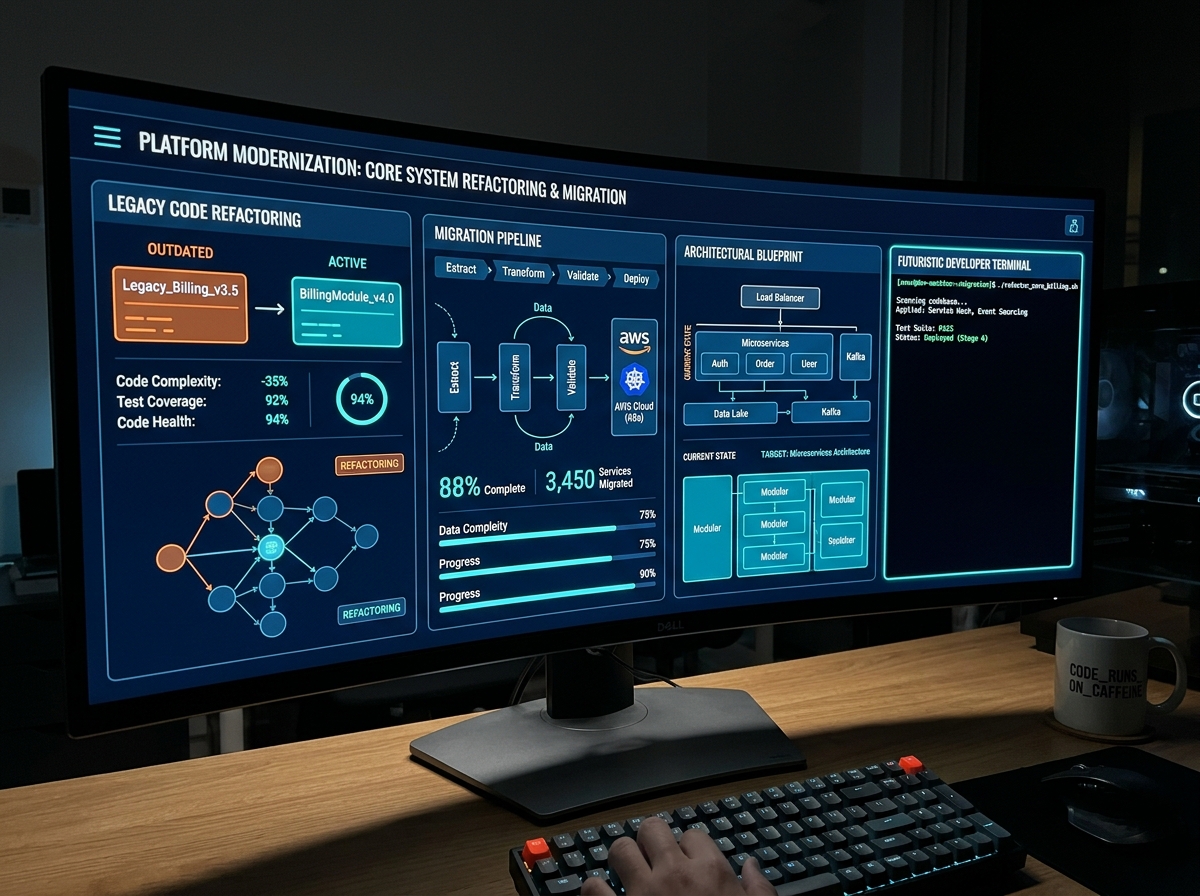
Decompose monolithic legacy systems into modular services without taking your operations offline. We execute phased data migration, maintain dual-run parity, and modernize the stack step by step.

Product Rescue & Takeover
Take over stalled, unfinished, or abandoned vendor codebases. We evaluate whether to refactor or rebuild, secure repository access, resolve critical bottlenecks, and resume shipping software on predictable timelines.

Code Health Audit
Independent, deep-dive code assessment for business leaders, CTOs, and investors. We inspect the repository to uncover technical debt, security liabilities, and extract undocumented business logic.
What you get
AI-assisted analysis
We read old code far faster, which cuts the cost of understanding before changing.
Refactor before rebuild
We keep what works. A rewrite from scratch is recommended only when the numbers prove it costs less over time.
Experience with migrations that can't afford downtime
Battle-tested parallel run and continuous data sync architectures that keep core revenue workflows fully operational.
Code Health Audit (1–2 weeks)
Get an objective, independent technical diagnostic before committing capital. We inspect the repository, analyze architecture debt, and deliver a clear written scorecard and readout session.
Know exactly what can be salvaged, refactored, or modernized without starting over.
How it works
Assess, then Plan, then Migrate in stages, then Cut over and retire — backed by a proven parallel-run architecture.
Assess
We audit the codebase, map architectural bottlenecks, evaluate security debt, and extract undocumented business logic.
Plan
We deliver an objective Refactor vs. Rebuild decision matrix, define API contracts, and construct a staged migration roadmap.
Migrate in stages
We incrementally rewrite or refactor modules while old and new run concurrently with continuous real-time data synchronization.
Cut over and retire
Once parity tests and live benchmarks pass, traffic routes 100% to the modern system and the old system is safely decommissioned.
The Parallel-Run Period
Existing Core Monolith
Processes untouched workflows with existing business rules. Remains active as the trusted fail-safe until every modern feature passes validation.
Modular Cloud Services & APIs
New high-performance services deploy incrementally. Features migrate route by route, receiving live traffic safely in production.
Typical use cases
Real situations where replacing, refactoring, or migrating delivered immediate business value.
Upgrading an Old Distribution System
A 15-year-old on-premise logistics ERP was critical to daily warehouse operations and order dispatch, but took months to change and could not connect to modern freight APIs or mobile barcode scanners.
We encapsulated the legacy core with modern REST/GraphQL APIs, decoupled inventory tracking into responsive web services, and migrated warehouse hubs one at a time without halting operations.
Moving a Legacy Database to the Cloud
A monolithic on-premise SQL database holding 12+ years of sensitive customer transactions was suffering from severe replication lag, backup failures, and nearing physical hardware end-of-life.
We engineered real-time Change Data Capture (CDC) replication to a managed cloud database. Both databases ran in parallel validation for 30 days before executing an instant zero-data-loss cutover.
Replacing an Unsupported Framework
A customer portal built on deprecated AngularJS and PHP 5.6 was failing compliance audits, exposed to unpatched CVEs, and impossible to recruit engineers to maintain.
Using the Strangler Fig pattern, we incrementally rebuilt customer routes in React/Next.js and modern microservices while preserving existing session states and backend authentication.
Frequently Asked Questions
Direct answers on Refactor vs. Rebuild, missing developers, cloud migration, and timelines.
Not sure whether to refactor or rebuild?
Get a written answer from a Code Health Audit.
Start with a Code Health Audit.
Tell us what system you're running, where it's stalled, or what codebase you need audited. We'll show you what can be salvaged, refactored, or modernized without starting over.
- 1We review your message and get back to you within 24 hours.
- 2We arrange a confidential technical call with a senior engineer.
- 3Clear Code Health Audit proposal (1–2 weeks) with zero obligation.